
Drying oak properly: why moisture content decides the result
The most common complaint about solid wood furniture has nothing to do with workmanship. It appears months later, in a heated room, because the timber was too wet when it was installed.
What moisture content actually means
Moisture content is the share of water in the timber, given as a percentage of the oven-dry weight. Freshly sawn oak sits at around 60 %. In a heated interior, timber settles at roughly 6 to 10 % depending on the season. The journey from 60 % down to single figures is the production step you cannot see in the finished product.
The point is not the target value alone but the difference. A table delivered at 12 % moisture into an office with underfloor heating keeps giving off water. It shrinks, the joints open, the top cups. That is not a material fault — it is physics that should have happened before dispatch.
Why we dry in house
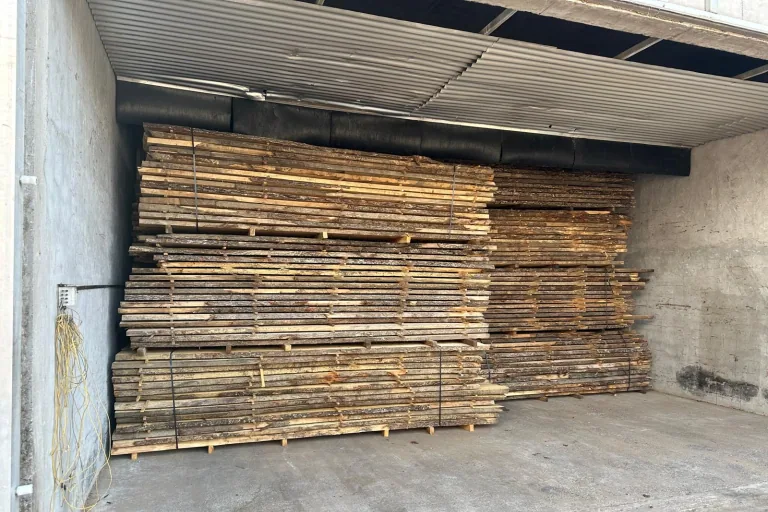
We have four of our own drying chambers with 350 m³ of capacity in total. For a company our size that is a deliberate investment, and it has one reason: whoever buys drying in buys a number on a delivery note. Whoever dries in house determines it.
In practice we bring series down to around 7 % as a rule, and about 6 % is possible. Which value is right depends on the destination — furniture for a Scandinavian winter with dry heated air and furniture for a Mediterranean project are not the same task.
I do not buy moisture content on paper. When the timber comes from outside, you get a number on a delivery note and you hope. If you dry it yourself, that number is yours — and so is the responsibility.
Where in the process we measure
Moisture is not checked once at the end but along the processing chain. The decisive moment is before gluing: if lamellas with different moisture contents are pressed together, they later work against each other and the glue line is where it shows.
Before dispatch the moisture content can be measured and documented on request. If your project requires such evidence, we clarify in advance what can be covered through an independent inspection body.
Customers from Germany and Scandinavia often ask for less than the usual 7 %, because their heated air is dry. That is not a problem, but it has to be said at the start, not once the series is already pressed.
What this means for your order
Three questions are worth asking any solid wood supplier before ordering: do they dry in house or buy timber dried? What target value do they run to? And can the moisture be measured before loading?
If the answers stay vague, that is a signal. Not because the supplier is dishonest, but because they simply are not controlling the value.
- Starting moisture of freshly sawn oak: approx. 60 %
- Final moisture of our series as a rule: approx. 7 %
- Down to approx. 6 % possible, depending on the target market
- Own chamber capacity: 350 m³ in four chambers
- Measurement before dispatch on request
All figures in this article refer to our own production in Usora. We currently hold no formal moisture certificate and no digital process documentation of the drying — we say that openly rather than implying otherwise.
Read on
A question about moisture in your project?
Tell us the target market, the indoor climate and the product. We will tell you which value we would run to — and what we can commit to.
Your direct contact: Haris Ćostović, deputy managing director. Communication in English and German.